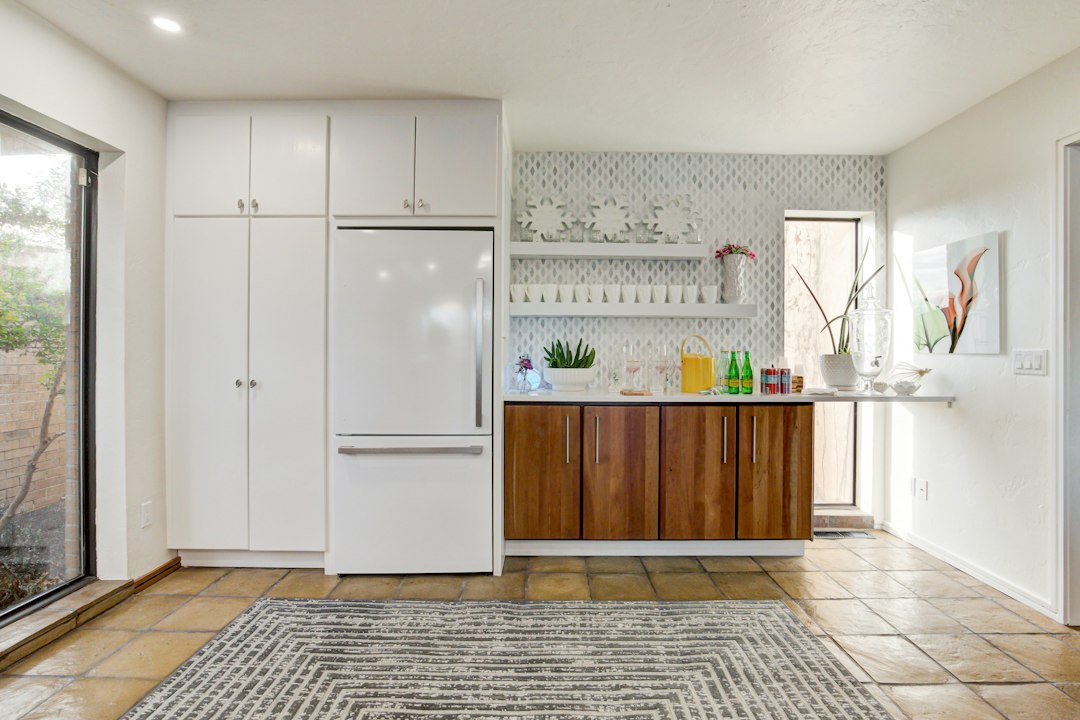
Measure for a new refrigerator by recording the opening’s narrowest width, lowest usable height and available depth, then comparing those figures with the exact model’s installation requirements. Also check door movement, drawer removal and the complete delivery route.
The old refrigerator’s advertised size is not enough. Two models with similar capacities can have different hinge heights, handle projections and ventilation needs. A refrigerator that fits while closed may still prevent a drawer from opening beside a wall.
This guide helps you prepare a measurement sheet before shopping. It does not replace the selected model’s installation instructions or a professional assessment of electrical, water or structural work.
Gather a measurement kit
Use a reliable tape measure, paper or a notes app, a pencil and a helper if the opening is difficult to access. A simple sketch is often clearer than a long list of numbers.
Record units beside every measurement. Do not mix inches and centimeters on the same sketch without clear conversion.
Keep photographs of the opening, nearby walls and delivery obstacles. They help an installer understand the setting, but photographs do not replace actual measurements.
Define the model you are comparing
Download the candidate refrigerator’s specification sheet and installation guide. Identify dimensions for the cabinet, hinges, doors and handles, plus any stated clearance requirements.
Do not rely solely on a retailer’s category name, such as counter-depth or standard-width. Those labels describe a type of product, not a guarantee that it fits your opening.
If a dimension is unclear, ask the manufacturer or retailer before ordering. Guessing that a handle is included can create a significant depth error.
Measure the kitchen opening
1. Clear access safely
Move small items away from the opening. Do not drag out a connected refrigerator by yourself just to measure behind it.
If the appliance must be moved, follow safe handling and disconnection procedures or use an installer. Water lines, electrical cords and flooring can be damaged by careless movement.
Start with accessible measurements and note which dimensions still need confirmation. A provisional note is better than an unsafe attempt to reach a hidden wall.
2. Measure width at several levels
Measure between the fixed surfaces at the front and, where accessible, farther back. Check near the top, middle and bottom.
Record the narrowest usable width. Cabinets, trim and walls may not be perfectly parallel, and a protruding molding can reduce the actual opening.
Mark anything that projects into the space, including handles on adjacent cabinets. Do not average several measurements and assume the refrigerator will fit the average.
3. Measure usable height
Measure from the finished floor to the lowest overhead obstruction. Check both sides and the rear where possible.
Account for upper cabinets, trim, lighting and the refrigerator’s hinge height. The visible cabinet above may not be the only limiting point.
Note floor changes or raised sections. A refrigerator can have adequate clearance at the front yet meet a lower overhead area when pushed back.
4. Measure available depth
Measure from the relevant rear boundary toward the front of the surrounding cabinets or the point beyond which projection becomes a problem.
Record obstructions such as a wall outlet, baseboard or water connection. Do not assume the refrigerator can sit flush against the bare wall.
Compare depth figures carefully: cabinet depth, depth including doors and depth including handles are different. Draw each on your sketch if the specification sheet lists them separately.
5. Add the required operating clearances
Use the exact installation guide to determine ventilation and installation space around the unit. Do not substitute a universal clearance number.
Compare the model’s total space requirement with the opening, rather than comparing only the metal cabinet dimensions.
If the measurements are very close, ask an installer to assess tolerances and access. A nominal fit on paper can leave no practical room to install or remove the appliance.
Check doors and drawers
6. Map the door swing
Look at walls, islands, handles and adjacent appliances. Compare the refrigerator’s open-door dimensions and the angle needed for normal use.
A door may open enough to reach a shelf but not enough to remove a crisper drawer. Check those requirements explicitly.
Use painter’s tape or a paper sketch to visualize projection without marking delicate surfaces. Treat this as an aid; the manufacturer’s dimensions remain the authority.
7. Check nearby traffic
Imagine the door fully open while someone stands in front of the refrigerator. Check whether another person can pass safely and whether an oven or dishwasher door creates a conflict.
Do not assess only the empty kitchen. Daily use includes people carrying food, opening drawers and unloading groceries.
If the aisle is tight, compare door configurations using actual dimensions rather than assuming one style is always better.
8. Plan maintenance access
Consider whether the refrigerator can be pulled out for service and whether water shutoffs and electrical connections remain accessible as required.
Do not enclose a freestanding unit as though it were a built-in appliance. Follow its installation requirements for the intended setting.
If cabinet alterations are necessary, establish the scope before buying. Trimming structural or finished cabinetry should not become a delivery-day surprise.
Measure the delivery route
Start at the vehicle access point and follow the entire route into the kitchen. Check exterior doors, internal doors, hallways, staircases, landings and turns.
Measure the narrowest clear opening, accounting for door stops and hardware. A doorway’s nominal size can be different from the usable space.
Check overhead clearance and turning space. A wide straight hallway does not guarantee that a bulky appliance can make a sharp turn at its end.
Ask the delivery provider which packaging and door-removal procedures it permits. Do not assume the crew will remove house doors, refrigerator doors or railings without prior arrangement.
For stairs or difficult access, obtain a professional delivery assessment. Avoid planning a risky lift based on a rough diagonal measurement.
Build a comparison sheet
For each candidate model, record the model number, cabinet dimensions, overall dimensions, required clearances, open-door dimensions and delivery requirements.
Beside each, write the corresponding measurement from your kitchen. Mark any unresolved item instead of leaving it to memory.
An example entry might say: opening width measured at three heights; narrowest figure recorded; model clearance requirement checked; adjacent wall swing still awaiting confirmation. This is more useful than a single note saying it should fit.
Do not confuse capacity with external size. Cubic-foot capacity describes storage volume, not installation compatibility.
Questions to ask before ordering
Ask whether the published dimensions include handles and hinges. Confirm what the delivery service measures, disconnects, removes and reconnects.
Ask what happens if the appliance cannot pass through the route or fit the opening. Understand the retailer’s current delivery and return terms directly rather than assuming a standard policy.
If you need a water connection, arrange qualified installation according to the model and local requirements. Do not improvise fittings because the refrigerator has already arrived.
Common mistakes
Do not measure only the old refrigerator. Do not use a wall-to-wall measurement while ignoring baseboards or overhead trim.
Avoid subtracting a guessed allowance for ventilation. Use the actual guide.
Do not assume counter-depth means flush handles or zero door projection. Door operation may require the cabinet to project.
Finally, do not round a tight opening upward. Record the real measurement and ask for an installation assessment when the margin is small.
Confirm the final measurements before payment
When you have selected a model, repeat the critical opening and route measurements with its installation sheet in front of you. Ask a second person to check any tight dimension.
Write down which measurements are confirmed and which still depend on an installer. Do not let a sales deadline turn an unresolved clearance into an assumption.
Keep the final model number with the measurement sheet. Similar model names can conceal different door configurations or external dimensions, so verify the exact unit on the order.
If the kitchen will be renovated before delivery, measure the finished opening again when work is complete. Planned cabinet sizes and actual installed dimensions can differ. The same applies if flooring, trim or door hardware changes along the delivery route.
Frequently asked questions
Is the old fridge width enough information?
No. Measure the opening and compare the new model’s complete installation requirements.
Do all refrigerators need the same gap?
No. Clearances vary by model and installation type.
Why check drawer removal?
Some drawers need the door opened wider than everyday shelf access. A nearby wall can prevent that.
Can the delivery team remove appliance doors?
Possibly, but confirm their procedure and the manufacturer’s allowance before ordering.
What if I cannot measure behind the old unit?
Record accessible dimensions and arrange safe movement or an installer assessment. Do not risk damaging connections to obtain one measurement.
Related guides
Sources
Illustrative photo: Anson Wilson / Unsplash. The photograph illustrates the topic; it is not a step-by-step demonstration.
Editorial note
Kitchen products and manufacturer instructions vary. When a product manual conflicts with general guidance, follow the instructions for your exact model.