Organize cookbooks by separating the books you cook from regularly from occasional reference books, then give each group a suitable shelf. Choose a place away from heat, steam, and splashes. Use a short recipe index to find favorites across books instead of rearranging the whole collection every time you need dinner inspiration.
A useful cookbook shelf is a working reference system. The order should help you choose a meal, locate the right page, and return the book without damaging it. This guide offers a practical household setup rather than an archival treatment for rare or valuable volumes.
Gather the collection and decide what belongs
Bring together cookbooks from the kitchen, living room, bedside table, and other storage spots. Include binders and booklets so you can see the full collection. Set loose paper recipes aside instead of pushing them back into random books.
Make three temporary groups: used regularly, wanted for reference or occasional projects, and ready to donate or pass along. A book can deserve a place because you enjoy reading it, even if you rarely cook from it. Label that purpose honestly rather than forcing every book into an everyday cooking shelf.
Check condition as you sort. Keep a wet or moldy book away from clean volumes and seek appropriate preservation advice, particularly for valuable family books. Do not spray a household cleaner onto pages or try to hide a musty problem inside a sealed kitchen bin.
Count the books you are keeping and note the tallest and deepest. Those dimensions matter more than buying a shelf because it looks right in a photograph.
Choose a shelf that protects the books
Look for a stable, clean location away from the sink, cooktop, and frequent steam. A shelf directly over a kettle may be convenient but exposes books to a different environment from a dry cabinet across the room. Avoid direct sunlight that repeatedly strikes the covers.
Check the shelf’s load rating and supports. Cookbooks can be heavy, especially large hardbacks. Do not add a long row of books to a decorative shelf without confirming it can safely support them.
Measure shelf depth and usable height, including the space lost to brackets or cabinet hinges. Books should not project awkwardly into a walkway or make a cabinet door press against their spines. Put heavy frequently used volumes at a comfortable height rather than above a difficult reach.
The Library of Congress recommends good housekeeping for books and keeping them off the floor. Its preservation guidance also addresses dusting and gentle handling. In a kitchen, that translates into choosing a clean sheltered shelf and making retrieval easy.
Choose one primary organizing system
| System | Useful when | Potential drawback |
|---|---|---|
| By topic | You look for baking, everyday meals, or a particular cuisine | Some books cover several categories |
| By author | You remember who wrote the recipe | Less helpful when you remember only the dish |
| By frequency of use | A small core collection does most of the work | Occasional books need a clear secondary location |
| By size within a topic | Shelf support and space are limited | Needs simple labels to keep categories visible |
Choose the system that matches the question you ask when cooking. If you usually think “I want to bake,” a baking group may be more useful than a purely alphabetical shelf. If you remember authors instantly, alphabetizing may be easier.
A practical combination is frequency first, then topic within each group. Keep everyday books nearby and occasional project books elsewhere. Avoid creating so many tiny categories that every new book requires a decision tree.
Arrange books so removing one is easy
Keep a small amount of working space on the shelf so you can grip a book without pulling hard on the top of its spine. Use stable bookends where needed. Do not pack a row so tightly that the neighboring books scrape as one is removed.
Group books of broadly similar size when practical. Very large books may need a different shelf or a modest horizontal stack with the heaviest volume at the bottom. Keep stacks small enough that reaching the lower book does not become a lifting project.
Give thin booklets a magazine file or a supportive folder if they slump between hardbacks. Label the container by topic so it does not become an anonymous paper collection. Keep oversized family recipe binders separate if they otherwise force the whole shelf into an awkward arrangement.
Test the layout by removing and replacing the three books you use most. If that action feels awkward when the shelf is dry and quiet, it will be worse when dinner is underway.
Create a small index of recipes you actually use
A personal index solves a different problem from shelf order: finding a specific recipe across several books. Start with favorites rather than cataloging every page. A notebook or a simple digital note is enough.
Record the dish name, book title, page number, and one practical tag such as weeknight, freezer, baking, or vegetarian. Add a note about a change only when it helps you repeat the result. For example: “Lentil soup — Everyday Kitchen, p. 84 — weeknight — use the larger pot.” That is a fictional entry illustrating the format.
Use the same book title each time so searching works. If a book has several editions, note your edition when page numbers differ. An index is most useful when it is small enough that updating it takes seconds.
Keep personal recipe references for your own use. Do not copy and republish whole books or large collections of recipes simply to make the index comprehensive.
Give loose recipes and family notes their own place
Sort loose recipes into a binder, folder, or file rather than tucking them permanently between unrelated pages. Keep the source or author information with each recipe. Put fragile originals in suitable protective storage and use a practical working copy when appropriate.
For a family collection, decide whether the priority is preserving the original handwriting or using the instruction during messy preparation. A photograph can help you read a delicate original without exposing it to flour and splashes every week.
Use a short review folder for recipes you want to try. After cooking, either add a useful reference to the index or let the paper go. Without that decision, a “try soon” pile can quietly grow larger than the cookbook shelf.
Set up a temporary cooking spot for the open book
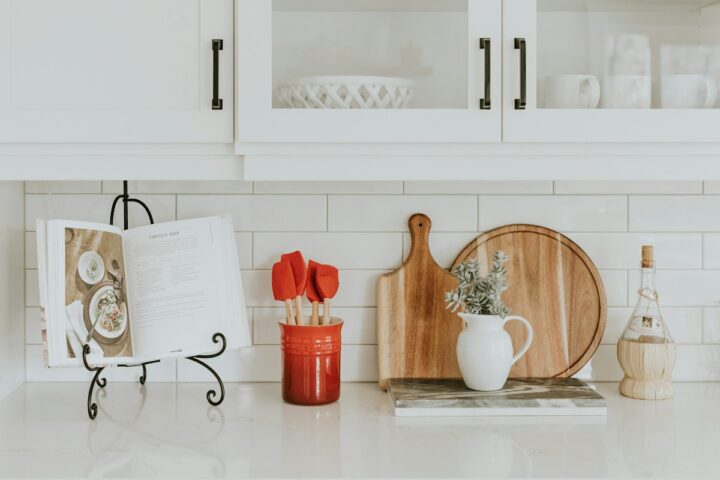
Keep a stable book stand or a clear area away from burners and splashes. Check that the stand supports the book’s weight and does not force a fragile binding flat. Set the page before your hands become wet or flour-covered.
The Library of Congress recommends clean, dry hands when handling books. In the kitchen, a simple habit is to wash and dry your hands before turning pages rather than wiping them quickly on a used cooking towel.
Leave room for ingredients and tools so the book is not pushed toward a hot pan. Our counter organization guide helps you plan that working area. For baking sessions, pair it with organizing baking supplies so the book and equipment have separate clear places.
Maintain the shelf without turning it into a project
Return books after cooking and remove temporary notes that have lost their purpose. During ordinary cleaning, dust the shelf and the books gently with an appropriate dry tool. Keep cleaning sprays away from paper and let a cleaned shelf dry fully before replacing the books.
Review the collection when new books arrive. If the shelf is full, decide what moves to secondary storage or leaves the collection before adding another unstable stack. Revisit categories only if you repeatedly fail to find what you need.
The best sign that the system works is simple: you can locate a book, find a favorite recipe, and put it back without rearranging the room. Decorative consistency is optional; easy use and reasonable protection are the real goals.
Frequently asked questions
Should cookbooks be organized by color?
You can do that if it helps you find them, but topic, author, or frequency is often more practical for cooking. Keep a separate recipe index if appearance is your main shelf order.
Can I keep cookbooks above the stove?
Choose a place away from heat, steam, and greasy splashes. A dry nearby shelf is usually more practical for protecting the collection.
How do I organize recipes from several books?
Keep a small personal index with the dish name, book title, page, and a useful tag. Start with recipes you already use instead of attempting to catalog the whole collection.
What should I do with a moldy cookbook?
Separate it from clean books and consult appropriate preservation advice. Valuable or sentimental books may need a conservator; do not spray household chemicals onto the pages.
Sources and care instructions
This guide provides general household guidance. Follow the instructions for your specific product where they differ.
Illustrative lead photograph by Haberdoedas on Unsplash. The photograph illustrates the topic; it is not a step-by-step demonstration.
Editorial note
Kitchen products and manufacturer instructions vary. When a product manual conflicts with general guidance, follow the instructions for your exact model.