To clean a fine mesh strainer, empty it promptly, rinse from the outside of the basket toward the inside, and wash both sides with dish soap and a soft brush. Support the mesh while brushing, rinse the rolled rim and handle connection, and let the strainer dry completely before putting it away. Use a dishwasher only if your particular strainer is labeled dishwasher-safe.
The difficult part is usually the thin layer of food caught between the wires, not the visible pieces in the bowl. Pushing harder can deform the basket without clearing those openings. This guide covers ordinary household mesh sieves used for flour, fruit, grains, and sauces. Fabric filters, powered strainers, and specialty laboratory screens need different care.
Check the strainer before washing
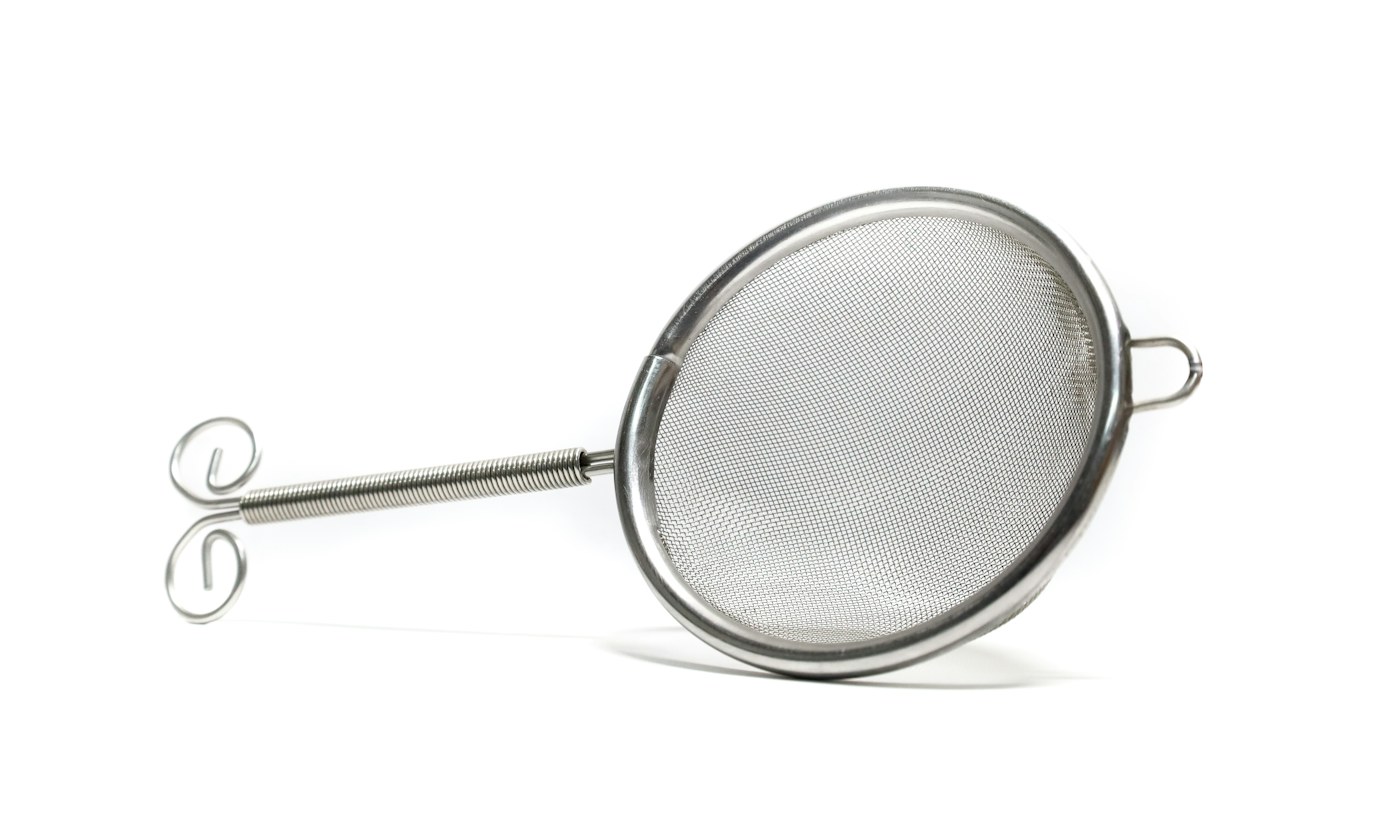
Look at the basket, rim, handle, and support loop in good light. Identify whether the screen is stainless steel, plastic, or another material, and look for a care label or the manufacturer’s product page. A metal basket does not mean every part tolerates a dishwasher; a wooden handle, glued joint, or decorative finish can change the answer.
Check for a loose rim, sharp wire, or gap where the screen joins the frame. Stop using a sieve with broken mesh that could shed wire into food. Do not run your fingers across a suspicious edge to see whether it is sharp. A soft brush is safer for inspection as well as cleaning.
OXO lists its 3-inch Mini Strainer as dishwasher-safe. That is a useful example of model-specific permission, rather than a rule for all mesh tools. If you cannot establish the material or care instructions, start with gentle hand washing.
Gather a few gentle cleaning tools
Set out dishwashing liquid, a soft dish brush, a non-scratch sponge, and a clean drying rack. A small soft brush is useful for the rolled rim, but avoid using a brush previously used for floors or bathroom cleaning. Choose bristles fine enough to reach the openings without behaving like stiff picks.
Use a bowl or basin large enough to hold the basket without forcing it flat. Keep knives and other sharp utensils out of the washing water. Steel wool, wire brushes, pins, and the tip of a knife are poor choices: they can damage the screen or leave fragments behind.
Rinse loose food out in the right direction
Empty larger scraps into the trash or an appropriate food-waste container. Hold the strainer so the convex outside of the basket faces the running water and the food-catching side faces down. A moderate stream moving through the screen in the reverse direction helps lift trapped particles back out.
Rotate the basket instead of increasing water pressure until it splashes across the counter. Work around the perimeter, where food often collects against the rim. If seeds or grains remain, use a soft brush on the food side while rinsing from behind, keeping fingers clear of any exposed wire.
Do this before flour, cooked starch, or sauce dries into a crust. If you are still cooking, a prompt rinse can make the later wash easier, but it does not replace washing with detergent. Put the rinsed tool in a designated dirty-dish area so nobody mistakes it for clean equipment.
Wash the basket without pressing it flat
Make warm soapy water and wet the entire strainer. Work over small areas with the brush, following the curve of the basket. Hold the frame securely and use light strokes; do not bear down on the center as though it were the bottom of a saucepan.
Wash both the concave and convex sides. Pay attention to the seam under the rim and the point where the handle attaches. Move the brush around these joints from different angles rather than trying to force a sharp tool inside them.
For dried residue, allow an ordinary washable metal basket to sit briefly in warm soapy water, then try brushing again. Avoid leaving mixed-material strainers submerged for hours. If progress stops, refresh the water and reassess the material instead of adding several cleaners. Never mix cleaning products.
Match the approach to the residue
| What is trapped | Practical next step | What to avoid |
|---|---|---|
| Dry flour | Empty loose powder first, then wash and rinse carefully | Grinding wet flour into the rim |
| Rice or cooked starch | Soften with warm soapy water, then brush both sides | Pulling hard enough to stretch the mesh |
| Berry seeds or pulp | Back-rinse and brush around the perimeter | Picking openings with a needle |
| Greasy sauce | Wash with fresh detergent solution and inspect again | Accepting a clear-looking but oily surface |
Persistent food should become easier to remove as it softens. If the surface instead looks pitted, torn, or flaky, the problem may be damaged material rather than dirt. A cleaning routine cannot repair corrosion or a failing joint.
Use the dishwasher only when allowed
For a dishwasher-safe model, remove obvious food first and arrange the strainer so water can reach the basket. Keep it clear of the spray arm, and do not wedge the mesh against a plate or heavy pan. Follow the manufacturer’s placement instructions if it specifies a rack.
After the cycle, inspect the mesh before storing it. A wash cycle can leave a seed under a rim even when the broad surface looks clean. Rewash any remaining residue rather than putting the tool away and hoping it will fall out next time.
Our guide to loading a dishwasher properly explains how crowded utensils block spray. The same principle matters for a shallow sieve: space around the tool is part of cleaning performance.
Dry, inspect, and store without crushing
Rinse until the water is clear and no slippery detergent remains. Hold the basket against a light background to look for blocked openings. Turn it around and check from the other side; food tucked under the frame may only be visible from one angle.
Let water drain on a clean rack with air reaching both sides. Avoid sealing a damp sieve inside a closed container. Once dry, hang it by its intended loop or place it where heavier cookware cannot press into the basket. Do not store loose knives inside it.
If your drawer is crowded, rearrange the tools before buying another organizer. A narrow compartment for sieves and small whisks may work better than stacking everything together. See our utensil drawer guide for a starting layout; check your drawer dimensions before adding dividers.
Fix recurring cleaning problems
If particles repeatedly lodge beneath a damaged rim, replacement may be more practical than increasingly aggressive scrubbing. Compare the joint with a photograph of the original model to distinguish normal construction from a loose edge. Ask the manufacturer about unexplained rust or shedding material.
If the strainer smells after drying, wash the frame and handle connection again, then clean the brush and drying area too. A clean basket placed on a dirty cloth can pick up residue again. If the screen stays blocked after gentle cleaning, stop before deforming it; use another suitable tool for the next task.
Frequently asked questions
Can I boil a fine mesh strainer to clean it?
Do not assume so. Plastic rims, grips, adhesives, and finishes may not tolerate boiling. Ordinary washing is the starting point; use a heat treatment only when the maker specifically allows it.
How can I tell whether the mesh is clean?
Inspect both sides against the light, check under the rim, and look for visible particles and greasy film. A clear view through the screen is useful, but it does not replace washing the handle and frame.
Should I replace a bent strainer?
A slight shape change is different from broken wire. Stop using one with sharp, torn, loose, or shedding mesh. Do not try to repair food-contact mesh with household glue.
Sources and care instructions
This guide provides general household guidance. Follow the instructions for your specific product where they differ.
Illustrative lead photograph by KAT on Unsplash. The photograph illustrates the topic; it is not a step-by-step demonstration.
Editorial note
Kitchen products and manufacturer instructions vary. When a product manual conflicts with general guidance, follow the instructions for your exact model.